Table Of Content
- Collcoll hides stairs and seats in pixellated wooden structure at Pricefx office
- Olympic Fish Pavilion (Barcelona, Spain)
- Guggenheim (Bilbao, Spain)
- Kathreiner's Morning Wood (Kathreiners Morgenlatte), a work by Sigman Polke
- Chiat/Day Complex (Venice, California)
- Atomic Habits for Architectural Professionals
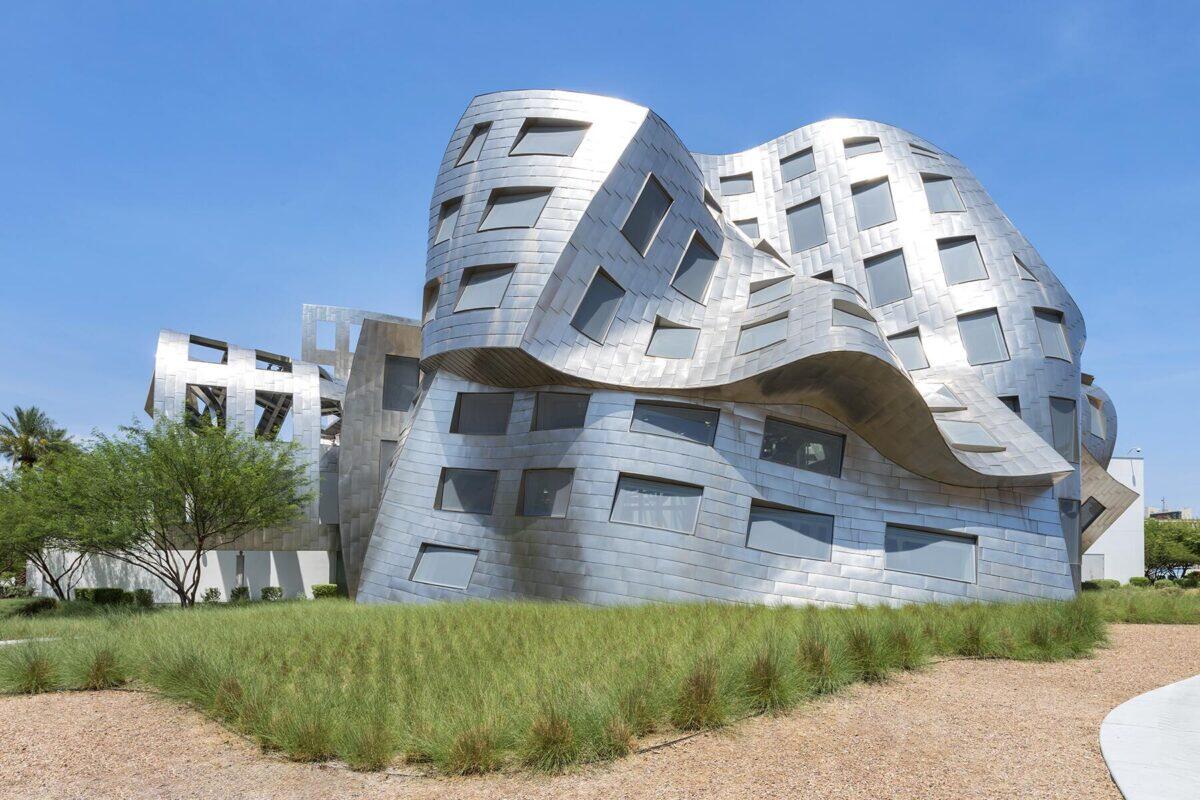
The inappropriate juxtaposition of seemingly unrelated details and elements became an aspect of deconstructivism—an architecture of fragments in unexpected arrangements, like an abstract painting. It was originally an extension, designed by Gehry and built around an existing Dutch colonial style house.[1] It makes use of unconventional materials, such as chain-link fences and corrugated steel. It is sometimes considered one of the earliest deconstructivist buildings,[2] although Gehry denies this. Although Gehry exercises vast creativity among his designs, there are some defining features that make his architecture iconic. His style is considered deconstructivist, a movement in postmodern architecture where elements of the design appear to be fragmented; they are often described as chaotic or disjointed.
Collcoll hides stairs and seats in pixellated wooden structure at Pricefx office
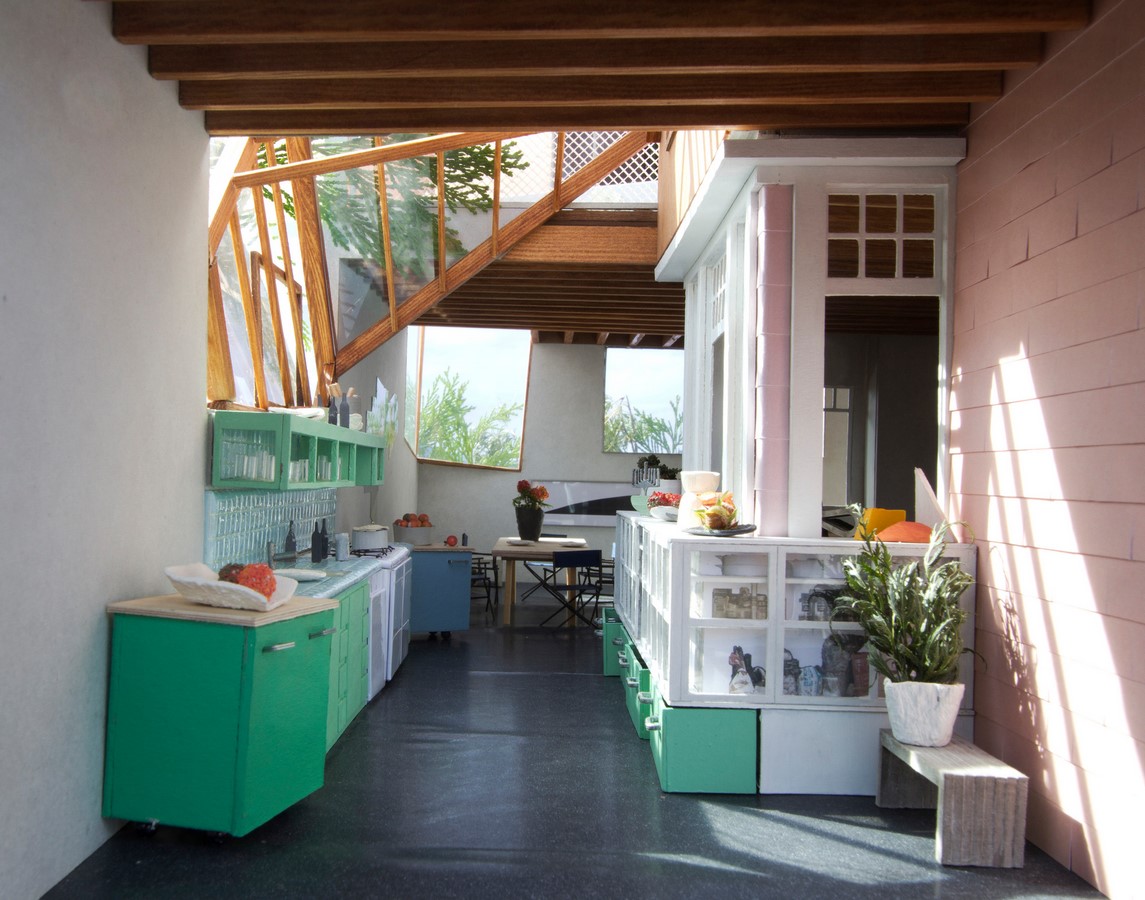
The apex of the old house peeks out from within this mix of materials, giving the impression that the house is consistently under construction. The entrance is barely discernible amidst the exterior’s jutting angles, which Gehry created from wood, glass, aluminum, and chain-link fencing. The old house’s apex peeks out from within this mix of materials, giving the impression that the house is consistently under construction. Gehry finished school in Los Angeles and relocated from the west coast to east coast. He attended—but later dropped out of—the Harvard Graduate School of Design, opting for a permanent stay in California. It’s here that he launched his Easy Edges furniture line constructed from layers of corrugated cardboard; although successful, he was still interested in designing buildings over industrial objects.
Olympic Fish Pavilion (Barcelona, Spain)
It was renovated in accordance with the other side, showing the old and new elements. This is especially evident when walking through the rooms of the house and go through the new doors placed by Gehry and original housing. Gehry Residence is located on the corner of 22nd Street and Washington Avenue in Santa Monica, California, United States.
Guggenheim (Bilbao, Spain)
Frank Gehry’s first house in Los Angeles - Domus IT
Frank Gehry’s first house in Los Angeles.
Posted: Sat, 19 Aug 2023 07:00:00 GMT [source]
"The force of the house comes from the sense that the additions were not imported to the site but emerged from the inside of the house," said Mark Wigley in the Museum of Modern Art (MoMA) catalogue for the seminal Deconstructivist Architecture exhibition, in which the house was featured. The angled, gabled roof, clad in a metal that glows almost pink at dusk, and the tilted skylights are unmistakably Gehry. To I.M. Pei and his two sons, Chien Chung and Li Chung; to Eliel and Eero Saarinen; to César and Rafael Pelli, we can now add Frank and Sam Gehry. When talking about the house’s design, Gehry also references the sense of movement in Dada artist Marcel Duchamp’s Nude Descending a Staircase and the unfinished quality of Abstract Expressionist artist Jackson Pollock’s paintings, which Gehry says look as though the paint was just applied. The resulting modest and casual appearance makes the house appear “thrown together,” an effect that required a great deal of work and planning to realize.
Kathreiner's Morning Wood (Kathreiners Morgenlatte), a work by Sigman Polke
"The house is very warm and communal, and all the vibrant spaces that Gehry devised really inspire creativity," says Jillian, who maintains a sculpture studio and jewelry workshop on the mezzanine level. "The kitchen is pretty small, and you can hear every sound that’s made all over the house. Occasionally Patrick and I use the Airstream parked in the garden for date night." Having resided in this quintessentially West Coast house for almost a year, Marquardt still wears the all-black uniform of a New Yorker—and has a formidable collection of new and vintage design to match. His penchant for neutral tones, luxurious materials, and rounded contours seems at odds with Gehry’s comparatively aggressive deconstructivism. But the interiors offer a study in harmonious contrasts; the living room’s lush Mario Bellini mohair sofa and handwoven Scandinavian wool rug commingle well with concrete floors, a concrete fireplace impressed with woodgrain patterns, and a ceiling of bare wooden planks.
Control Moisture in Tighter Building Designs with Vapor Barriers
Celebrating creativity and promoting a positive culture by spotlighting the best sides of humanity—from the lighthearted and fun to the thought-provoking and enlightening. In 2012, Gehry designed the set for the Los Angeles Philharmonic's opera production of Don Giovanni, performed at the Walt Disney Concert Hall. Although Marquardt always “shied away from angular things,” his recent purchase of a glass cocktail table with zigzagging iron legs may also be a sign that the house is rubbing off on him. A German expat brings a minimalist sensibility to a wildly sculptural house by the famed architect.
Chiat/Day Complex (Venice, California)
The Dutch colonnial home was left in tact and the new house was built around it. Holes were made, walls were stripped, torn down and put up, and the old quiet house became a loud shriek of contemporary style among the neighboring mansions--literally. Neighbors hated it, but that did not change the fact that the house was a statement of art entwined with architecture. When Frank Gehry and his wife bought an existing house in Santa Monica, California, the neighbors did not have the slightest idea that the corner residence would soon be transformed into a symbol of deconstructivism. Gehry, however, knew something had to be done to the house before he moved in. His solution was a bold one in the 1970's that involved the "balance of fragment and whole, raw and refined, new and old" and would strike up controversy.
Frank Gehry Architect, Los Angeles Architecture - e-architect
Frank Gehry Architect, Los Angeles Architecture.
Posted: Wed, 21 Feb 2024 08:00:00 GMT [source]
Gehry House becomes a monograph with a complicated relationship between conflict within and between the forms. The skylights were designed as separate entities, each with its own identity. None of the skylights were perceived as connected to each other, any relationship between them is haphazard and accidental. Weekly updates on the latest design and architecture vacancies advertised on Dezeen Jobs.
Atomic Habits for Architectural Professionals
The now-famous Gehry House is the story of a middle-aged architect who forever changed his notoriety—and his neighborhood—by remodeling an old house, adding a new kitchen and dining room, and doing it all in his own way. Although Gehry tried to maintain the same style, which allows the original design, to determine the addition, the house underwent significant change. The residence became much more “finished”, awakening the angry voices of those who strongly supported the original deconstructivist aesthetics. In 1991 due to the Gehry family's growth which involved two boys, the house had to be expanded. Even though Gehry tried to maintain the same style of the house, allowing the original design to determine that of the addition, the house went through significant changes.
Shrader regraded the site, installed a pea-gravel approach shaded by olive trees, and added front and rear courtyards paved with reclaimed cobblestones. Most significant, to provide structure and intimacy, he introduced lush terraced gardens with built-in seating and low walls made of raw chunks of recycled concrete. From 1994 to 1996 a couple buildings by Gehry for a Public housing project were realized in Goldstein, part of Frankfurt-Schwanheim (1994)In 1997, Gehry vaulted to a new level of international acclaim[2] when the Guggenheim Museum Bilbao opened in Bilbao, Spain. Hailed by The New Yorker as a "masterpiece of the 20th century", and by legendary architect Philip Johnson as "the greatest building of our time",[28] the museum became famous for its striking yet aesthetically pleasing design and its positive economic effect on the city. The completed Spiller House, half a block from the Venice Beach boardwalk, is a pair of boxlike units, one designed for the owner to live in and the other to host tenants.
Gehry will primarily use corrugated metals which give his look an unfinished appearance. This has its fair share of critics; however, his long-standing commitment to this material has created a consistent aesthetic throughout the years. In 1968, when Frank Gehry started work on a combined studio and residence in Malibu, California, for artist Ron Davis, the architect was still an outlier, just beginning his revolutionary experiments with forms and materials. Nearly half a century later, Gehry has won virtually every honor his profession has to offer. And the rhomboidal corrugated-metal-clad live/work space he created for Davis?
Since its construction in 2002, the Peter B. Lewis Building has housed the Weatherhead School of Management at Cleveland’s Case Western Reserve University. The building exterior is classic Gehry, with ribbons of stainless steel unfurling from a brick base. Named after Peter B. Lewis, chief executive and president of Progressive Insurance, Gehry's building in the Case Western Reserve campus was a $62 million project with 152,000 square feet of space. Lewis and Gehry have had a long professional and personal career dating back to Lewis' commissioning Gehry to design his home, which was never built. Constructed of stainless steel, the Gehry Tower is memorable for the noticeable twist in its outer façade on a ferroconcrete core, making optimal use of the relatively small piece of ground on which it is located.
However, the house became more open and comfortable for Gehry and his family, and the increased finish, more delicate materials, and greater coherence reflected. Skylights and glass floors allowed light from above to filter down into the house’s lower level, filling it with light. It’s rare for an architect to become a household name, but the ones who earn this distinction have their designs lauded for decades to come.
In the case of the Gehry Residence, the owner-architect wished to negate the associative meanings of a middle-class, suburban domicile. The challenge this time would be very different from the original house, not only because the Gehrys were older and wanted both an elevator and space for possible live-in help. They continued to be so happy in their old house that they were not sure they really wanted to move, however sensible the idea might be. Gehry, trying to navigate between his desire to create another house and the ambivalence that he and his wife shared about leaving their old one, came up with a solution. By then Sam Gehry, an architectural designer, was working at his father’s firm, and Frank decided that he and his son would design the house together.
Frank Gehry’s imposing new house in Santa Monica might seem to be the polar opposite of the “unfinished” look he sought for his renovation of a modest 1920s Dutch colonial, also in Santa Monica, four decades ago. The current residence was designed in collaboration with his younger son, Sam, who has been active in the firm since 2008, when Gehry entrusted him with the creation of the Serpentine Gallery Pavilion in London’s Hyde Park. The new house bears little resemblance to Gehry’s youthful venture, which instantly became a landmark of residential design.


No comments:
Post a Comment